Cut Instrumentation Costs with Industrial Wireless Solutions
Industrial wireless instrumentation is worth it because it can reduce the total installed cost and disruption of adding new measurement points, while still supporting plant-grade reliability, security, and scalable coverage when built on an industrial wireless standard and architecture.
Are you still paying $25,000 just to add a single data point to your DCS?
For decades, chemical and petrochemical plants have relied exclusively on hardwired instrumentation to monitor their most critical processes. But as facilities expand and the demand for real-time data grows, the cost of running miles of conduit, pulling copper wire, and managing complex installations has become unsustainable.
Up to 72% Cost Savings
Wireless vs. Wired Instrumentation Per Point
- In a recent project evaluation, a senior engineer noted that adding a single wired point into a Distributed Control System (DCS) costs between $20,000 and $25,000. By switching to a wireless solution, that same data point was integrated for just $5,000 to $7,000, a massive 72% cost reduction, not to mention the hundreds of man-hours saved.
- Actual costs vary by hazardous classification, cable tray and conduit availability, shutdown constraints, and I/O and marshalling scope, but the cost gap between new wired points and wireless expansions is consistently driven by field labor and installation complexity.
Example Cost Comparison (Single New Measurement Point)
| Cost Element (Typical) | Wired Point | Wireless Point |
|---|---|---|
| Total Installed Cost (example range) | $20,000 to $25,000 | $5,000 to $7,000 |
| Schedule Impact | Longer, multi-trade | Faster, fewer trades |
| Disruption Risk | Higher | Lower |
While many plant managers recognize the cost benefits of wireless technology, concerns about reliability, battery life, and protocol compatibility have historically held them back. However, modern industrial wireless networks have evolved. Today’s systems deliver wired-like performance, sub-second update rates, and multi-year battery life, making them the new standard for hazardous and complex environments.
This article explores why wireless instrumentation is transforming the chemical and petrochemical industries, how it works, and what makes a truly scalable wireless network.
We will cover wireless network evolution, why sensor mesh can create latency and battery penalties, what infrastructure-based mesh changes, and the business outcomes chemical plants are targeting.
The Evolution of Industrial Wireless
Wireless sensor networks are not a new concept. Honeywell introduced the industry’s first wireless sensor network, the XYR 5000, back in 2004. Since then, the technology has undergone significant evolution.
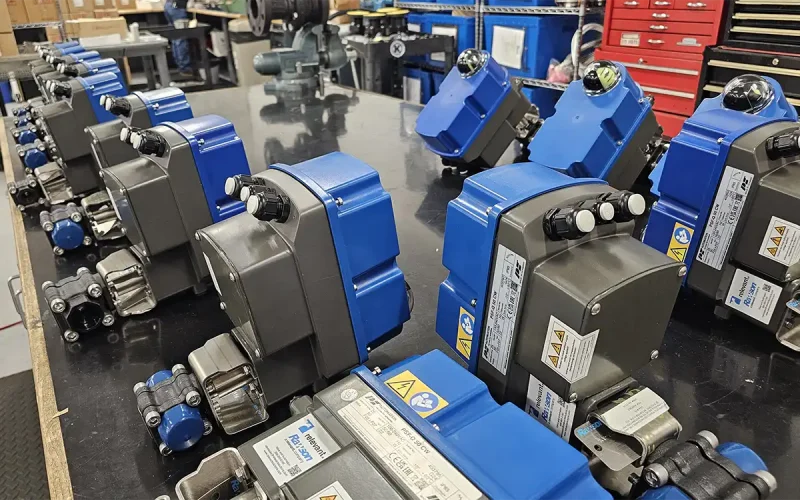
By 2011, systems became compliant with ISA100 Wireless, an international standard born from the requirements of customers, communication experts, and international vendors. Today, the latest generation of SmartLine Wireless Transmitters provides absolute pressure, differential pressure, and gauge pressure monitoring with unprecedented accuracy and reliability.
ISA100 was created to define how industrial wireless systems handle reliability, security, and interoperability in automation environments, which is why it often shows up in buyer evaluation checklists.
These systems are no longer just for non-critical monitoring; they are actively used in upstream, midstream, and downstream oil and gas, petrochemical processing, and tank gauging operations where failure is not an option.
This is the point where many plants move from pilot projects to standardized deployment, and it is also where vendors and integrators are expected to support network design, commissioning, and lifecycle management.
How Modern Wireless Networks Outperform the Rest
Not all wireless networks are created equal. The most common architecture used by many vendors is the “Sensor Mesh Network.” While functional, it has severe limitations for large-scale chemical plants.
The Problem with Sensor Mesh Networks
In a traditional sensor mesh, each transmitter acts as a repeater, hopping the signal from one device to the next until it reaches the gateway. This creates two major problems:
- High Latency - Signal latencies can take up to a minute as data bounces through multiple devices.
- Rapid Battery Drain - Because transmitters are constantly working as repeaters, their batteries drain rapidly. Some vendors require proprietary replacement batteries that cost upwards of $250 each.
For large facilities, ask vendors to quantify worst-case latency, hop count behavior, battery assumptions, and how performance changes as the network grows, because those are the hidden failure points in brownfield scaling.
The Solution: Infrastructure-Based Mesh
Modern solutions, like Honeywell’s OneWireless, utilize an infrastructure-based mesh network. Instead of transmitters acting as repeaters, dedicated Field Device Access Points (FDAPs) handle the heavy lifting.
- Real-Time Performance - Transmitters communicate directly with the FDAPs, allowing for sub-one-second update rates.
- Maximum Battery Lifetime - Because transmitters aren’t burdened with repeating signals, they achieve multi-year battery life. Furthermore, they utilize standard, off-the-shelf lithium-ion D-cell batteries, drastically reducing maintenance costs.
- Unmatched Scalability - Powered infrastructure allows facilities to easily scale from a handful of transmitters to thousands of devices across the plant.
Sensor Mesh vs. Infastructure-Based Mesh: A Side-by-Side Comparison
| Feature | Sensor Mesh Network | Infrastructure-Based Mesh (OneWireless) |
|---|---|---|
| Signal Latency | Up to 60 seconds | Sub-1 second (0.5 sec) |
| Battery Type | Proprietary (~$250 each) | Standard D-cell (off-the-shelf) |
| Battery Life | Drains rapidly (repeater duty) | Multi-year lifespan |
| Mesh Architecture | Transmitters act as repeaters | Dedicated FDAPs handle mesh |
| Protocol Support | Single protocol | Dual: WiHART + ISA100 |
| Firmware Upgrades | Manual / not available | Over-the-air (OTA) |
| Scalability | Limited by battery drain | 100s to 1,000s of devices |
Infrastructure-based designs are typically favored when plants need predictable performance, simpler device power strategy, and a scaling path that does not turn transmitters into permanent network routers.
Why Chemical Plants Are Making the Switch
The shift toward wireless instrumentation is driven by measurable business impacts. Facilities that adopt comprehensive wireless networks experience benefits that extend far beyond initial installation savings.
The Business Impact of Wireless Integration
- Dual Protocol Flexibility - The best systems communicate with both WiHART and ISA100 protocols simultaneously. This is critical for plants using equipment from multiple vendors, such as Bentley Nevada Wireless Vibration transmitters, which rely exclusively on ISA100.
- Over-the-Air Management - Modern wireless device managers allow for over-the-air provisioning to integrate and commission devices instantly. They also support over-the-air firmware upgrades, a feature not offered by all competitors, making lifecycle management significantly easier.
- Hazardous Location Readiness - Today’s Field Device Access Points are Class 1/Div 2 and Zone 2 rated, holding FCC, IECEx, and ATEX certifications, ensuring they meet the strict safety requirements of petrochemical environments.
- Predictive Maintenance Power - By deploying wireless sensors across previously unmonitored equipment, plants can achieve 30–50% reductions in unplanned downtime.
The real ROI comes when wireless removes the cost barrier to instrument more assets, giving reliability and operations the data coverage needed for earlier detection, faster troubleshooting, and fewer emergency work orders.
If you are scoping a wireless expansion alongside DCS, instrumentation, or network design, explore Relevant Solutions’ instrumentation and automation services. For common accessories and supporting hardware, Shop Relevant’s industrial product catalog can help streamline procurement.
Conclusion
The question is no longer whether wireless instrumentation is reliable enough for your plant, the question is how much capital you are wasting by continuing to pull wire.
With flexible deployment, wired-like performance, easy-to-use interfaces, and low lifecycle costs, modern wireless networks provide the visibility needed to optimize production and prevent failures before they occur.
A practical next step is to identify the highest-value blind spots, define update-rate and hazardous-area requirements, then validate architecture fit, protocol support, and lifecycle tooling before expanding plant-wide.
Frequently Asked Questions (FAQs)
How Do I Choose Between ISA100 Wireless and WirelessHART?
ISA100 Wireless is commonly evaluated for standard-driven industrial automation requirements, while WirelessHART is widely used for wireless instrumentation ecosystems. Many plants prioritize solutions that can support both to reduce vendor lock-in and simplify mixed fleets.
What Update Rate Is Realistic for Industrial Wireless Instrumentation?
Update rate depends on device configuration, network architecture, and site RF conditions. Industrial wireless solutions often publish specifications for update rates and network behavior, which should be validated during design and commissioning.
Is Industrial Wireless Safe for Hazardous Petrochemical Areas?
It can be, but only when the specific access point and field devices have the correct approvals for your area classification and are installed per the vendor’s requirements. Always verify certifications against your site standards.
Does Wireless Really Improve Predictive Maintenance Outcomes?
Wireless improves predictive maintenance when it expands coverage, reduces manual rounds, and enables earlier detection. Outcomes depend on how the plant operationalizes the data into alarms, workflows, and maintenance actions.